A large rug can make a living room look complete in a photograph. But photographs rarely show the extra chair brought in when relatives visit, the dining table sharing the same floor area, or the route everyone takes between the sofa and balcony.
This is where many rug-buying decisions go wrong. People measure the room, look at the sofa and choose the largest size their budget allows. Yet the right rugs are determined by the furniture arrangement and the activities taking place around it, not simply by the total floor area.
A Mumbai 2BHK: One Living Room, Several Competing Uses
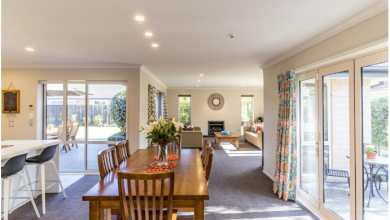
Consider a compact Mumbai apartment where the living and dining areas share one continuous space. The sofa, television unit and coffee table occupy one end, while the dining table sits nearby.
A single oversized rug may extend beneath both arrangements without actually improving either. Dining chairs can catch its edge when pulled backwards, food crumbs collect in the pile, and the rug can make an already busy floor feel crowded.
A more considered approach is to define the seating group separately. A rug large enough to connect the sofa, coffee table and at least the front legs of the main seating can establish a clear living-room zone. The dining area can remain uncovered.
This is not a rule against large rugs. It is a recognition that a shared room does not necessarily need one continuous floor covering.
A Jaipur Villa: More Floor Space Does Not Automatically Mean a Bigger Rug
Now consider a single-floor Jaipur villa with a separate drawing room and family sitting area. The drawing room may be arranged for formal visitors, while the family space handles everyday television viewing and informal gatherings.
Using one enormous rug simply because the room is spacious can produce an awkward result. If the seating is arranged in a compact group, a rug extending far beyond the furniture may look disconnected from the arrangement.
A large rug makes sense when the furniture grouping genuinely occupies a broad footprint. In a room with separate seating clusters, two appropriately sized area rugs may define the areas more clearly than one oversized piece.
The decision should follow the room’s actual layout, not its square footage alone.
When Does One Large Rug Work Better Than Two Smaller Rugs?
One large rug usually makes sense when the room has one connected seating arrangement. It creates a shared base beneath the furniture and prevents individual pieces from appearing visually detached.
Separate rugs become useful when a room has distinct functions or furniture groups. A living-dining combination, a large drawing room with two seating arrangements, or a lounge with a reading corner may benefit from separate floor zones.
Use one large rug when:
- The seating arrangement forms one clear group.
- The rug can sit beneath the main furniture without obstructing doors.
- The exposed border around the furniture looks balanced.
Consider separate rugs when:
- The room serves two distinct purposes.
- Furniture groups are positioned far apart.
- One continuous rug would interfere with dining chairs or regular movement.
The useful measurement is the furniture footprint, including the space needed to move around it. Room dimensions alone cannot settle the decision.
Rug Design Should Follow the Room’s Existing Visual Weight
A room with a patterned sofa, detailed curtains, and decorative furniture already has several competing visual elements. Adding a dense Persian carpet may introduce another strong pattern.
In that setting, a restrained modern rug or a softly patterned design may be more appropriate. Conversely, a room with plain upholstery, simple furniture, and large areas of empty flooring can accommodate a more detailed traditional rug.
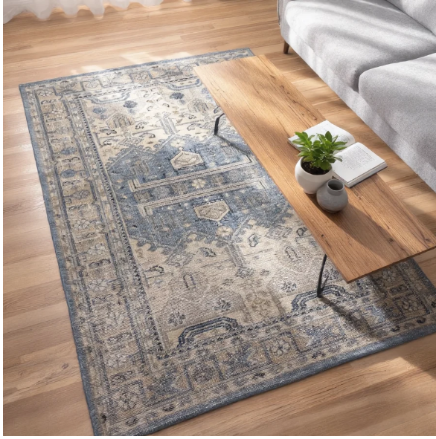
Color needs the same attention. Blue rugs can connect with navy upholstery, wooden furniture or cooler wall shades, but the exact blue matters. A saturated cobalt rug behaves differently from a muted dusty blue.
Similarly, green rugs can work with neutral upholstery and natural wood, while bright abstract designs need enough visual breathing room. If the room already has strong colors, a rug with several competing shades may make the arrangement feel unsettled.
The point is not to match every cushion to the rug. It is to decide which element should carry the strongest pattern or color.
Budget Changes the Buying Decision, Not the Design Logic
A budget-conscious household may need one rug to work around existing furniture for several years. In that situation, a practical size, manageable design and suitable construction matter more than buying a fashionable oversized piece.
A premium buyer may have more room to coordinate the rug with upholstery, artwork or a planned furniture layout. A high-end home may also have multiple seating areas, making separate area rugs or a custom-sized piece more appropriate.
But spending more does not solve a layout problem. A costly Persian carpet can still look misplaced if its proportions do not suit the furniture. Equally, a well-selected contemporary rug need not be expensive to make a compact seating arrangement feel complete.
The best purchase is the one that fits the room’s use and visual structure.
The Better Question Is How Much of the Floor Should the Rug Occupy
Online rug catalogues make it easy to filter by color, pattern, material, construction, and size. That is useful when browsing modern, traditional, or abstract designs.
However, product filters cannot determine whether a particular living room needs one large rug or two smaller ones. That requires looking at the furniture, movement, and activities within the space.
Before buying, mark the proposed rug dimensions on the floor using masking tape. Move around the furniture, pull out dining chairs, and check door clearance. The outline often reveals problems that a product photograph cannot.
Rugs should clarify a room’s layout, not just cover more floor. In many Indian homes, choosing where the rug ends is just as important as deciding where it begins.