Large-scale construction is a different animal from commercial renovation. The sites are bigger, the timelines are longer, the crews are larger, and the power demands are spread across areas that can span hundreds of thousands of square feet. A high-rise going up in a city center, a highway interchange being rebuilt, a new logistics warehouse breaking ground on a greenfield site these are environments where power infrastructure is not just a convenience. It is a core operational requirement that determines whether work happens on schedule or does not happen at all.
For most of construction history, the answer to power on large sites was fixed generators, temporary electrical distribution, and the months-long process of getting a utility connection established before meaningful work could begin. That model still exists, but it is being challenged in a serious way by portable Industrial Power Station systems that have reached the capacity, durability, and runtime necessary to compete with fixed infrastructure on sites that would previously have seemed beyond their reach.
The Temporary Power Problem on Large Sites
Getting electrical power to where it is actually needed on a large construction site is an underappreciated logistical challenge. Temporary distribution panels get installed at fixed points. Cable runs stretch across the site. As work progresses, the area being worked moves away from the distribution point, and extension cable runs get longer, voltage drop becomes a real problem for sensitive equipment, and the number of trip hazards multiplies with every additional meter of cable on the ground.
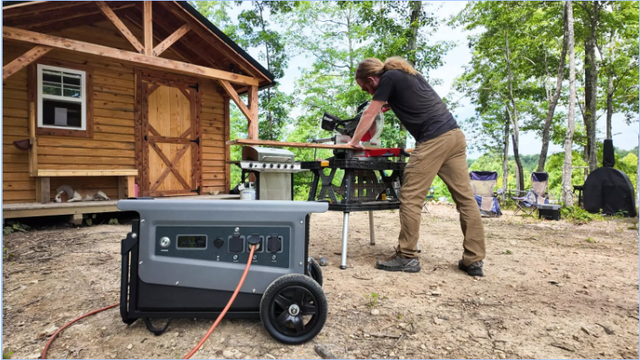
On large civil engineering projects, the distance between where power is available and where power is needed can be significant enough that running tools from temporary distribution is genuinely not practical for crews working at the far end of a site. Portable power changes this entirely. A unit that travels with the crew, positioned within a few meters of where tools are being used, eliminates voltage drop problems, eliminates cable runs across active work zones, and gives site managers the flexibility to reposition power capacity as work fronts move across the site.
Handling the Load Profile of a Large Construction Crew
A crew working on a large civil or structural project is not running the same tool set as a finishing crew on a renovation. Tower crane auxiliary systems, concrete vibrators, rebar cutting and bending equipment, dewatering pumps, and formwork tools all place heavy and often simultaneous demands on available power. Startup surge loads from large motors can run three times the rated running wattage, which means a system that cannot handle peak surge will trip under load rather than delivering consistent output.
SOUOP’s industrial range addresses this with high surge capacity built into the inverter design, meaning tools that draw heavy startup current can operate reliably without causing the unit to fault out mid-operation. The 5,000 watt continuous output available in their top-specification units, combined with expandable battery modules, means a well-configured system can support a full crew’s tool load through a standard working shift without interruption.
The pure sine wave output that industrial-grade battery systems deliver is also relevant here. Large construction sites increasingly use precision survey equipment, laser levels, and electronic control systems for formwork and concrete placement that require clean power to function accurately. Running these instruments from a fuel generator introduces harmonic distortion that affects readings. Battery systems with pure sine wave inverters eliminate this problem entirely.
Multi-Zone Site Power Deployment
On a truly large construction site, a single power system is not the model. The practical approach is multiple units deployed across different work zones, each positioned to serve the crew operating in that area. This distributed approach to site power has several advantages over centralized temporary distribution.
When one zone finishes its work for the day, the unit serving that zone can be repositioned to support a zone where work is ramping up, without any electrical infrastructure changes. Units can be charged overnight from a single site power connection and deployed across the site during working hours, decoupling the question of where grid access exists from the question of where work is happening. And when work fronts move, power capacity moves with them, rather than requiring new cable runs or temporary panel relocations.
An Industrial Power Station designed for genuine field deployment rather than controlled indoor use needs to handle the physical conditions of a large construction site. Dust is constant. Water from rain, concrete work, and ground conditions is frequent. Equipment gets moved across uneven terrain. Units that are not built to withstand these conditions become maintenance problems that undermine the operational advantages they were supposed to deliver. SOUOP builds its industrial range to IP-rated waterproof and dustproof standards that address the actual conditions of large outdoor construction environments.
Night Work and Round the Clock Operations
Large-scale infrastructure projects frequently run night shifts, either to meet project timelines or because certain work types, particularly in urban environments, are restricted to overnight hours to minimize traffic and noise impact on surrounding areas. Night work on a construction site requires lighting across large areas and continued tool operation through hours when grid-based recharging may be the only option.
Battery industrial power systems support continuous operation through night shifts with the same reliability as daytime use. Their low noise output is particularly valuable for overnight urban construction where diesel generator noise has historically caused conflict with residential and commercial neighbors. Several major infrastructure contractors have reported that switching to battery power systems for night work has eliminated complaints from neighboring properties that were previously causing project delays and regulatory attention.
Solar Integration for Extended Remote Projects
Large infrastructure projects in remote locations, road construction through sparsely populated regions, pipeline work, and resource sector site preparation frequently operate far from any grid connection for extended periods. On these projects, fuel logistics for generator operation becomes a significant cost and operational constraint. Fuel has to be transported to site, stored safely, and managed through the full duration of the project.
Solar panel integration with battery industrial power systems offers a meaningful alternative for remote large-scale projects. Units that recharge from solar during daylight hours and discharge through working hours and overnight can operate in genuine energy independence for the duration of a project. The capital cost of the solar panels and power systems is offset against fuel logistics savings that on a long remote project can be substantial.
Large-scale construction is evolving. The sites that run the most efficiently over the next decade will be the ones that moved power capacity from fixed infrastructure to flexible, portable systems early enough to build the operational knowledge to deploy them effectively.